Proof
What the assessor receives.
Why this page exists
Every shop in this market claims audit-readiness. The claim costs nothing to make, so it carries no information. What carries information is the artifact: the thing that lands in an assessor’s inbox, in the format they read it in.
Everything below is emitted by the reference stack — a demo organisation running the same pipeline, the same scanners and the same controls we field for clients. No client artifact appears on this page. What is on display is the shape — which is the part you are actually trying to evaluate.
Evidence pack
The export the pipeline produces on demand. Not assembled the week before the audit — emitted by the same build that ships the code.
evidence pipeline · drawn from the capture below
-
validate 5
- Source checkout
- Pipeline hardening checkCC7.1
- Infrastructure-as-code validationCC8.1
- Secrets scanCC6.2
- Test environment setup
-
static scan 6
- Dependency vulnerability scanCC7.1
- Infrastructure misconfiguration scanCC6.1
- Policy-as-code evaluationCC6.3
- Static code analysisCC7.1
- Software bill of materialsCC7.1CC8.1
- Vulnerability matchingCC7.1
-
live infrastructure 4
- Audit-trailed deployCC8.1
- Rollback and monitoring baselineA1.2
- Live configuration assessmentCC6.1CC6.6
- Deploy policy checkCC6.1CC6.7CC8.1
-
DoD compliance 1
- DoD host benchmarkCC7.1A1.2
-
emit evidence 1
- Package evidence
evidence-2026-05-13.zip
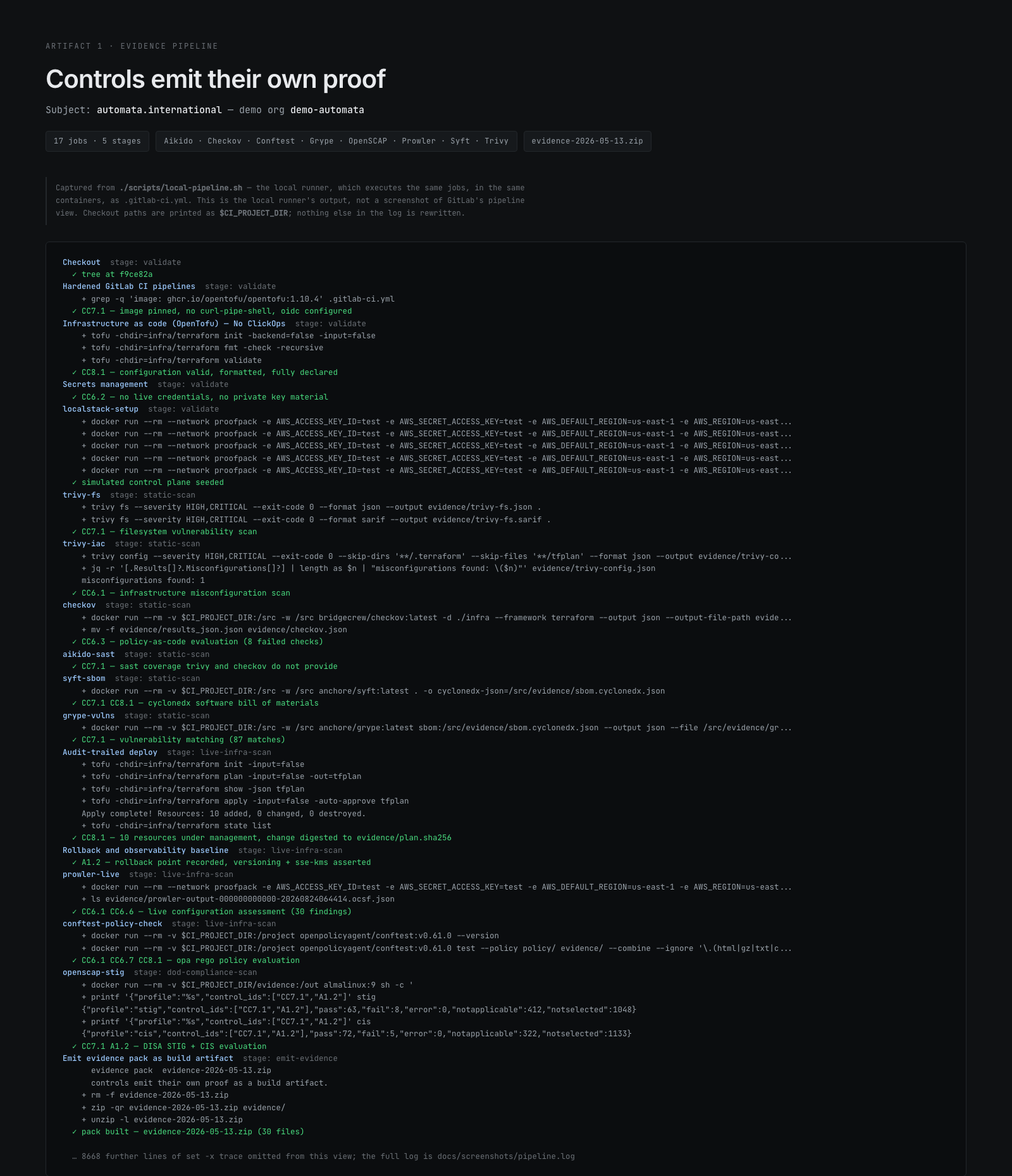
evidence-2026-05-13.zip as a build artifact.Control-to-artifact inventory
The index an assessor opens first: a control, the artifact that proves it, when that artifact was last emitted, and by which job. Controls and infrastructure point at each other rather than describing each other.
control inventory · drawn from the capture below
10 / 10 traced
| control | emitted by |
|---|---|
| CC6.1 | misconfiguration scanlive configuration assessment |
| CC6.2 | secrets scan |
| CC6.3 | policy-as-code evaluation |
| CC6.6 | live configuration assessment |
| CC6.7 | audit-trailed deploy |
| CC7.1 | dependency scanvulnerability matchingDoD host benchmark |
| CC7.2 | rollback and monitoring baseline |
| CC8.1 | audit-trailed deploy |
| CC9.2 | monthly drift review |
| A1.2 | DoD host benchmark |
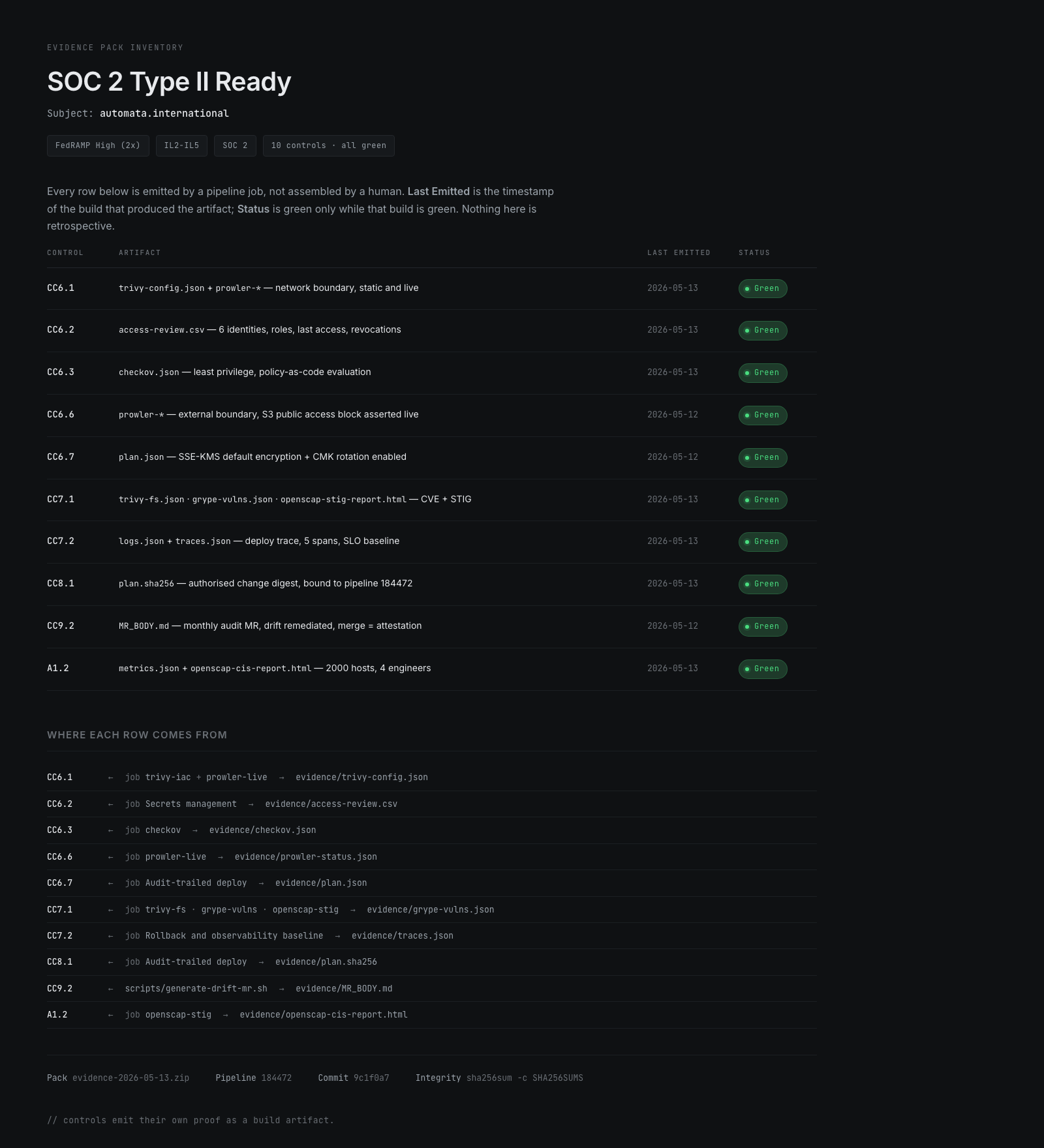
Status is green only while that build is green
— nothing here is retrospective.Monthly audit merge request
What the retainer produces every month: drift found by the scanners, the fix as a diff, and a merge that is itself the attestation. No memo, no console screenshot, no consultant assembling a binder in month eleven.
drift, fixed · drawn from the capture below
- caughtHIGH · firewall rule in
sg.tfopen to0.0.0.0/0 - fixedSSH scoped to a trusted management CIDR
- mergedreviewer approval, timestamped · control CC6.1
- re-scanned0 high · 0 critical
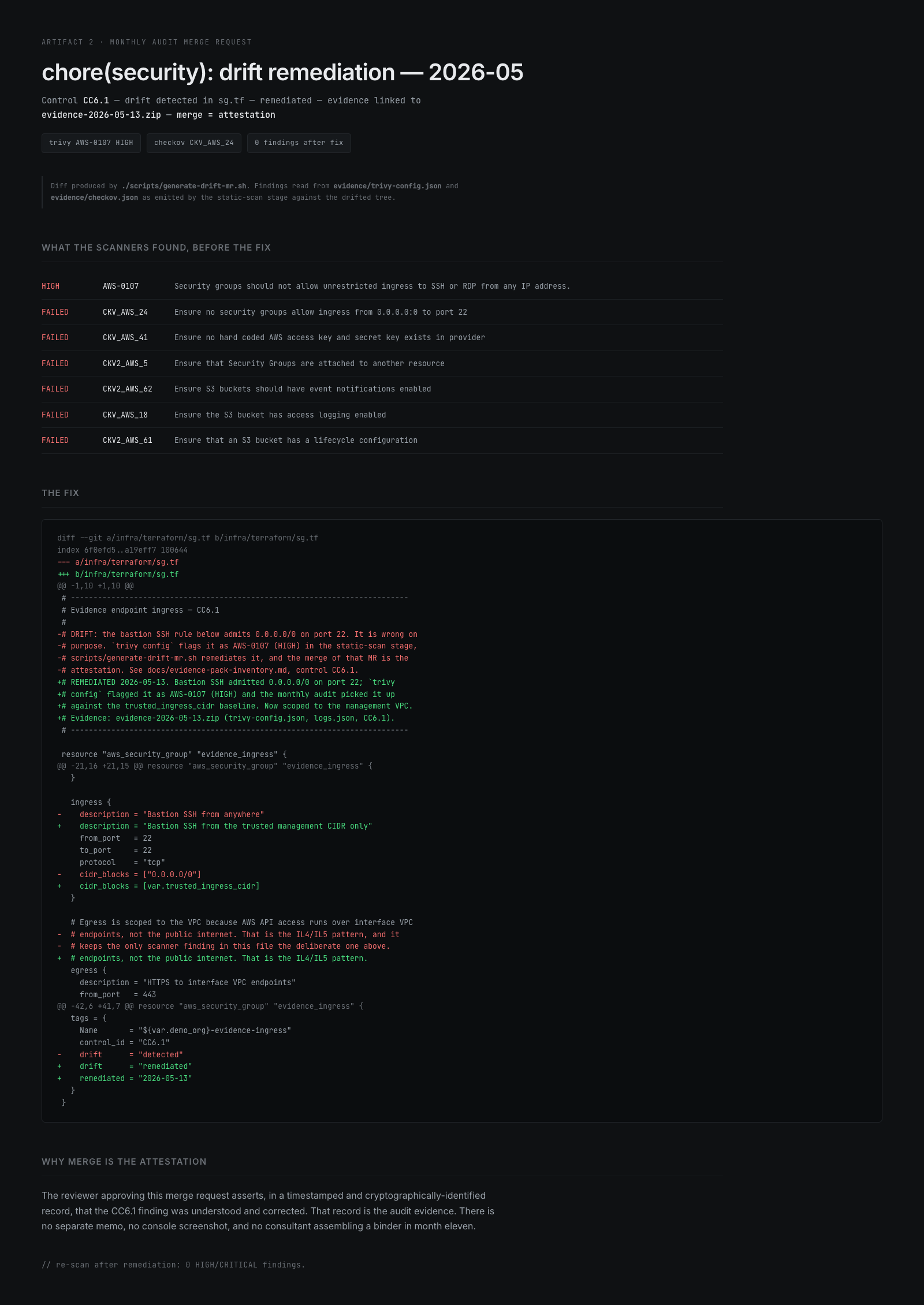
sg.tf, remediated, and
linked to the pack it was found in. The reviewer approving this merge
makes a timestamped, cryptographically identified assertion — that
record is the audit evidence.Host baseline — DISA STIG
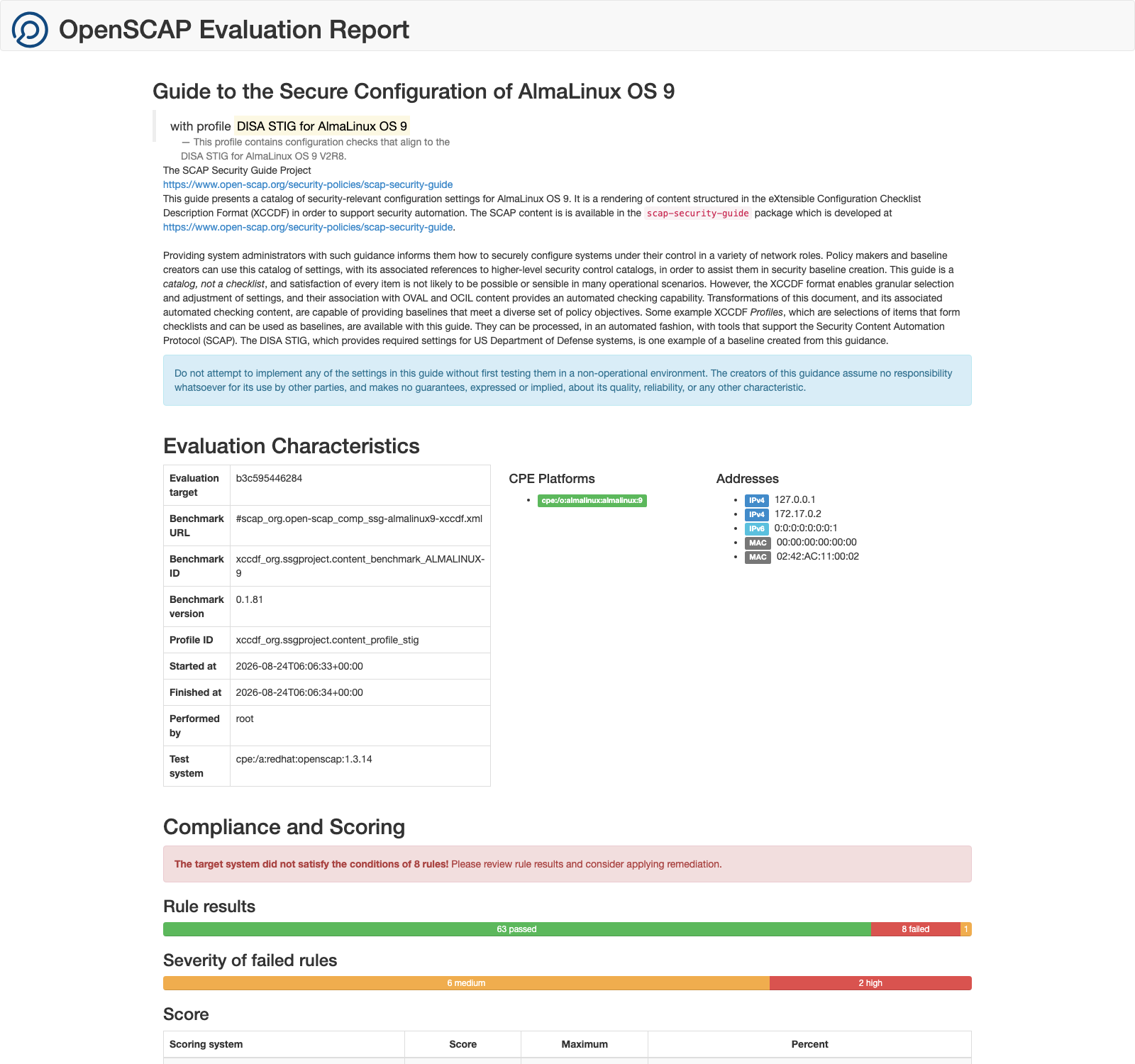
The DoD layer. A host benchmark evaluates the server against the DISA STIG and CIS profiles on every run, and the report ships inside the same pack as the cloud evidence.
server hardening · drawn from the capture below
One method, many bodies
The through line under the four artifacts above. A control is implemented once; a framework is a reader of it. The pack is not rebuilt per body — the same run answers to each in that body’s own numbering, which is why adding a framework costs a mapping and not a project.
one method, many audits · drawn from the capture below
| register | SOC 2 | NIST 800-53 | FedRAMP | DoD IL2–5 |
|---|---|---|---|---|
| control walk10 SCF controls | 10 / 10mapped | 10 / 10mapped | not read | not read |
| cloud scan1 run | 17requirements | 177requirements | 45requirements | not read |
| host benchmark1 datastream | CC7.1 · A1.2controls | not read | not read | 63 / 8STIG pass / fail |
| one checkS3 object versioning | 4criteria | 17controls | 5controls | not read |
From the crosswalk on the proof page · FedRAMP read at Moderate rev 4 · DoD read at the host layer
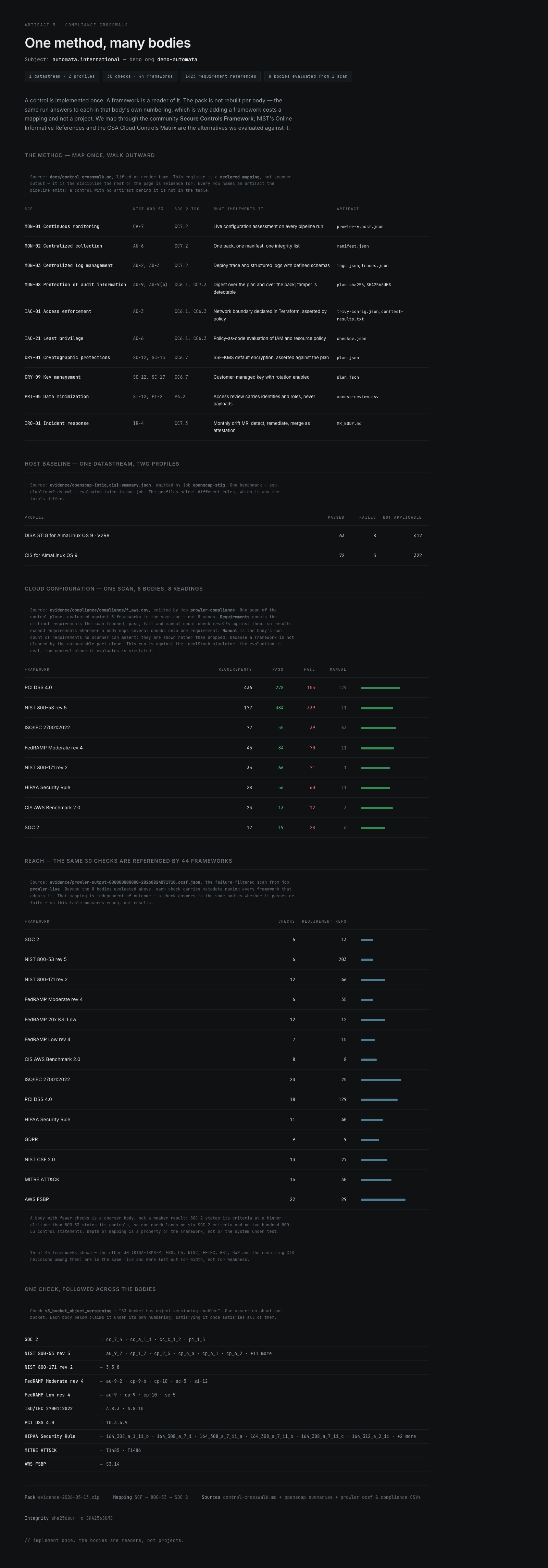
We map through the community Secure Controls Framework, then walk SCF → NIST 800-53 → SOC 2. NIST’s Online Informative References and the CSA Cloud Controls Matrix are the alternatives we evaluated against it. Only the first register is our assertion, and every row of it names an artifact the pipeline emits — the rest is scanner output. The eight-body evaluation is one scan read eight ways, not eight scans, which is the whole economic claim: a new framework costs a mapping, not a project.
What these artifacts cover
| boundary | FedRAMP High · DoD IL2–IL5 · SOC 2 · NIST 800-53 / 800-171 |
|---|---|
| portability | One codebase shipping commercial cloud and air-gapped on-premises by an identical process |
What is not here
A client’s artifact, and we will not send one. A shop that shows you another client’s evidence pack is telling you exactly what it will do with yours. The pages above are the reference stack, which is ours to publish.
What we will do is walk you through it live. The first ten minutes of every fit check is a demonstration of this pipeline running — and under an NDA, we can go further.
Book a 30-minute fit check
Ten minutes of us showing you something real we built or fixed. Twenty minutes on your pipeline and your compliance deadline — and a straight answer on what you need, including when the answer is nothing from us.